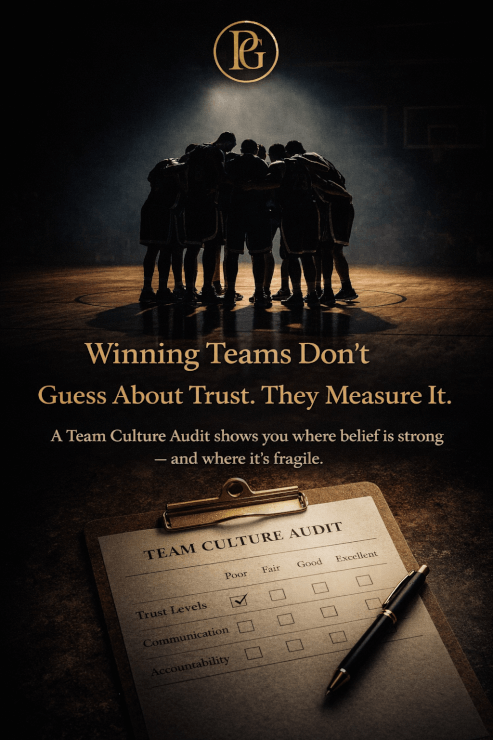
Winning Teams Don’t Guess About Trust. They Measure It.
02/22/2026
By Paul Garwood
Every successful program talks about trust. Few actually evaluate it.
Trust is often treated like a feeling. Coaches assume it is there because practices run smoothly or because players get along. But real trust is not revealed in comfort. It shows up in conflict, correction, and pressure. It appears in the fourth quarter, in tough film sessions, and in how teammates respond to adversity.
Winning teams do not leave that to chance. They measure it.
A Team Culture Audit gives programs clarity. It shows you where belief is strong and where it is fragile. It identifies the difference between surface-level unity and deep-rooted trust.
When belief is strong, players communicate directly. They accept coaching without defensiveness. They hold each other accountable without damaging relationships. Leaders set standards and teammates respond with commitment. Pressure does not divide the group. It strengthens it.
When belief is fragile, hesitation appears. Players avoid hard conversations. Accountability feels personal. Correction creates resistance. Standards fluctuate depending on mood or circumstance. In those moments, talent alone cannot carry the team.
The truth is simple. Trust impacts performance.
Communication improves when trust is high. Effort becomes consistent. Roles are embraced. Tough losses become learning moments instead of breaking points. Without trust, even the most skilled roster struggles to stay aligned.
A Team Culture Audit examines the real dynamics inside your program. It looks at trust between players and coaches. It evaluates communication patterns. It studies accountability systems. It compares the standards you speak about with the standards you actually live.
The purpose is not criticism. It is clarity.
You cannot strengthen what you do not identify. You cannot reinforce what you do not understand. Measurement creates awareness. Awareness creates alignment. Alignment creates results.
Championship programs measure everything that matters. Shooting percentages. Turnovers. Defensive efficiency. Conditioning metrics. Yet many fail to measure the culture that drives those numbers.
If your communication breaks down under pressure, trust may be fragile.
If effort shifts game to game, standards may not be internalized.
If accountability feels inconsistent, belief may be unstable.
The best teams do not wait for adversity to expose those weaknesses. They evaluate early. They address gaps directly. They reinforce strengths intentionally.
Winning teams do not guess about trust. They measure it.
And when they do, they gain something more valuable than motivation. They gain direction. They gain alignment. They build a foundation that can handle pressure, conflict, and expectation.
If you want sustainable success, start with the question that matters most.
Do we truly know where our trust stands, or are we just assuming it is strong?
A Team Culture Audit answers that question.